An education page for anyone learning about diamonds or buying one. It was built mainly for my business students: diamonds are the setting for projects, data analysis, and assignments in several of my courses, and this page helps students build the domain knowledge that work requires. Start with the 4Cs, the shared language used to describe diamond quality, then see how natural and lab-grown diamonds differ, how to read a grading report, and where to learn more through selected articles and videos.
Quality
The 4Cs
The Gemological Institute of America (GIA) created the 4Cs (carat, color, clarity, and cut) as a universal way to describe diamond quality. Two diamonds of the same weight can differ widely in price because of the other three Cs.
Carat Weight
Carat measures weight, not size. One carat equals 0.2 grams and is divided into 100 points, so a 0.75-carat diamond is a "75-pointer." Larger diamonds are rarer, so the price per carat rises as weight increases, not just the total price.
0.50 ct1.00 ct2.00 ctIllustration only: doubling the weight does not double the visible size.
Color Absence of color
Colorless diamonds are graded on GIA's D-to-Z scale, from D (colorless) to Z (light yellow, brown, or gray). Each letter is a defined range, judged against master stones under controlled lighting. Most diamonds in jewelry stores are colorless to near colorless; the N-to-Z range is less common in jewelry. Diamonds with more color than Z are graded separately as fancy color.
D–FColorless
G–JNear colorless
K–MFaint
N–RVery light
S–ZLight
Tints are approximate; color is graded face-down against master stones, not on screen.
Clarity Inclusions and blemishes
Clarity describes internal features (inclusions) and surface features (blemishes), judged under 10× magnification. The GIA scale has 11 grades in 6 groups. Many diamonds in the middle grades look clean to the unaided eye.
FLFlawless
IFInternally flawless
VVS1–2Very, very slightly included
VS1–2Very slightly included
SI1–2Slightly included
I1–3Included
Cut Light performance
Cut is about how well a diamond's angles, proportions, and finish return light as brightness and sparkle. It is the most complex C to assess. GIA gives a cut grade to standard round brilliant diamonds in the D-to-Z range, based on seven components.
Excellent
Very Good
Good
Fair
Poor
Beyond the 4Cs Also on the report
Polish
Smoothness of the diamond's surface, graded Excellent to Poor. For an Excellent cut grade, polish and symmetry must both be Very Good or Excellent.
Symmetry
Exactness of the outline and the shape, placement, and alignment of the facets, graded Excellent to Poor. Poor symmetry can make a diamond look flat.
Fluorescence
Glow under long-wave ultraviolet light, described as None, Faint, Medium, Strong, or Very Strong. About 25% to 35% of diamonds fluoresce, mostly blue. GIA treats it as an identifying characteristic, not a grade.
Origin
Natural or lab-grown?
Both are real diamonds: pure carbon in the same crystal structure. The difference is where and how they formed, and that difference matters for disclosure, grading, and price.
Natural diamond
Lab-grown diamond
Origin
Formed by heat and pressure deep in the earth, then mined
Grown in a factory from a small diamond seed
Material
Essentially the same chemical, optical, and physical properties and crystal structure
How it is made
Mined, then cut and polished
HPHT (high pressure, high temperature) or CVD (chemical vapor deposition), which builds the crystal layer by layer from carbon-containing gas
Telling them apart
Not by eye. Laboratories use advanced gemological and spectroscopic testing; screening devices help jewelers separate the two.
Labeling (U.S.)
May be called "diamond"
Must be clearly qualified, for example "laboratory-grown," "laboratory-created," or "[manufacturer name]-created" (FTC Jewelry Guides)
Not the same as look-alikes. Cubic zirconia and moissanite only look like diamond. They have different chemical and physical properties and are not diamonds, natural or lab-grown.
Paperwork
Reading a grading report
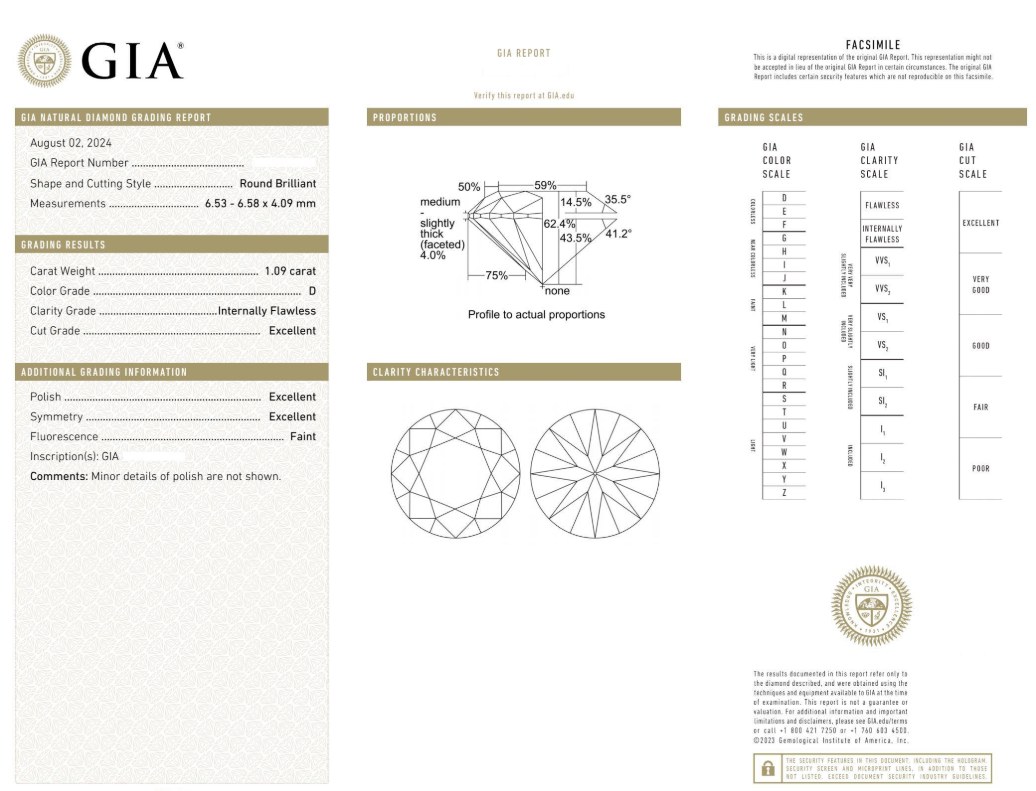
An independent grading report records a diamond's 4Cs and identifying details. Here is what each part of a typical report means.
Sample GIA Diamond Grading Report. Click to enlarge.
Report numberUnique ID; it can be checked online with the issuing laboratory and is often laser-inscribed on the diamond's girdle.
Shape and measurementsOutline shape (such as round brilliant) and dimensions in millimeters.
Carat weightRecorded to the hundredth of a carat (for example, 1.01 ct).
Color gradeA letter on the D-to-Z scale.
Clarity gradeOne of the 11 grades, with a plot showing where the main inclusions are.
Cut gradeFor standard round brilliants: Excellent to Poor, plus polish and symmetry.
FluorescenceHow the diamond reacts to ultraviolet light; used for identification.
Who grades diamonds
Grading laboratories
A grading report is only as reliable as the laboratory behind it. These are four widely recognized independent laboratories. Each lets you check a report number on its website.
Set your priorities.Decide which of the 4Cs matter most to you and where a lower grade is acceptable.
Ask for an independent report.Check the report number with the issuing laboratory.
Get the origin in writing.The receipt should state natural or lab-grown.
Compare like with like.Compare price per carat only across the same shape, carat range, color, clarity, and cut.
Check the policies.Read the return, upgrade, and warranty terms before you pay.
Go further
Articles and videos
Selected research, readings, and videos on diamond quality and origin. More will be added over time.
Research articles
Sally Eaton-Magaña, Troy Ardon, Christopher M. Breeding, and James E. Shigley, “Natural-Color D-to-Z Diamonds: A Crystal-Clear Perspective,” Gems & Gemology, 56(3), 318–335, 2020. Read at gia.edu ↗
Christopher M. Breeding, Sally Eaton-Magaña, and James E. Shigley, “Naturally Colored Yellow and Orange Gem Diamonds: The Nitrogen Factor,” Gems & Gemology, 56(2), 194–219, 2020. Read at gia.edu ↗
Yun Luo, David Nelson, Troy Ardon, and Christopher M. Breeding, “Measurement and Characterization of the Effects of Blue Fluorescence on Diamond Appearance,” Gems & Gemology, 57(2), 102–123, 2021. Read at gia.edu ↗
Sally Eaton-Magaña and James E. Shigley, “Observations on CVD-Grown Synthetic Diamonds: A Review,” Gems & Gemology, 52(3), 222–245, 2016. Read at gia.edu ↗